
Metal Stamping Glossary
Definitions of the common terms used across metal stamping and fabrication—from blanking and coining to progressive dies and tolerances.
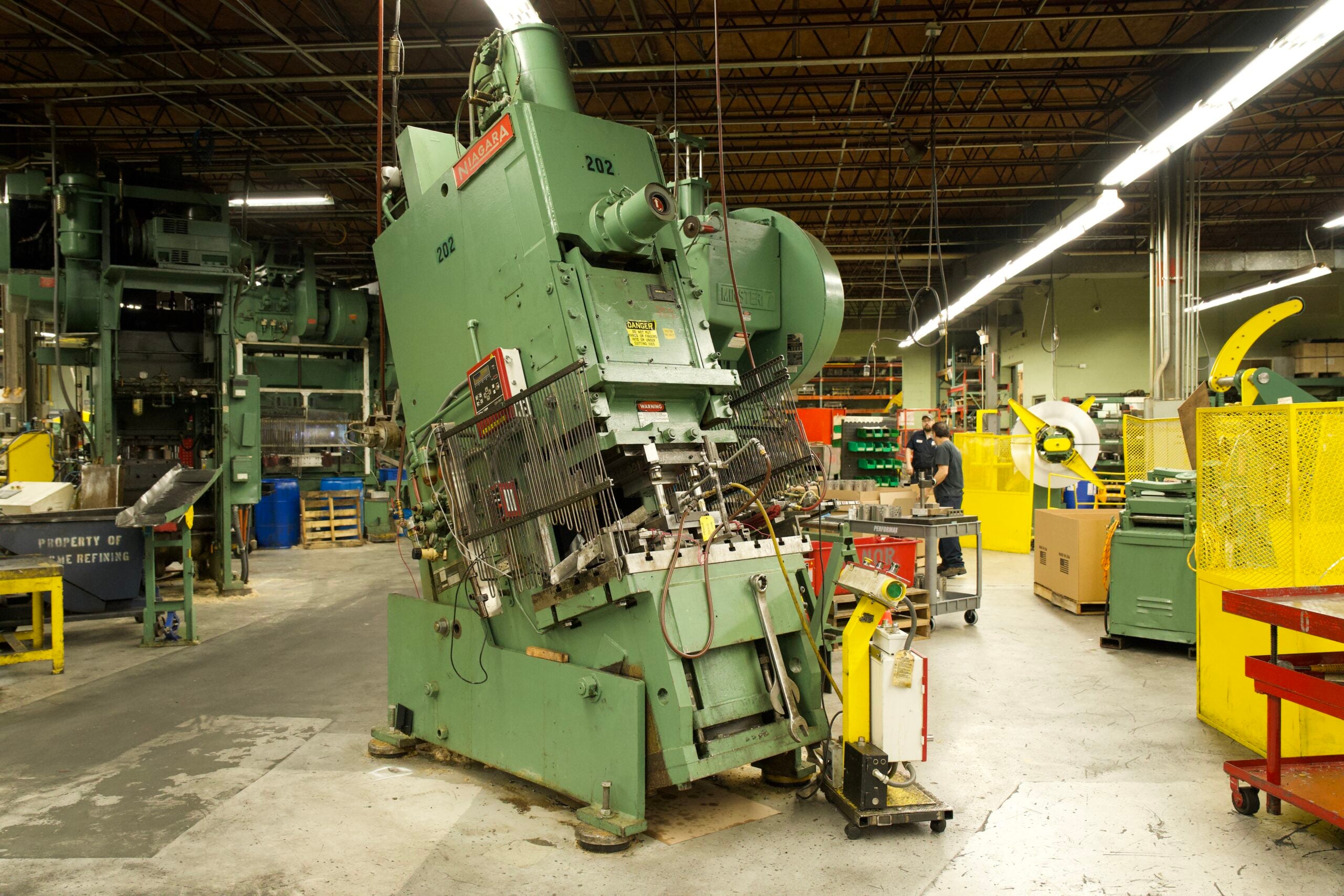
Manor Tool & Manufacturing is a premier provider of metal stamping services. We specialize in bending, forming, punching, and deep-drawn stamping and can handle production sizes ranging from low-volume prototyping and short runs to high-volume progressive runs. We can fabricate new tooling or run existing dies from our advanced, 32-press facility.
Glossary of Terms
Our in-house experts at Manor Tool have compiled this glossary of common metal stamping terms to help our customers and other readers understand the common terminology used in our industry.
Barrel finishing
A barrel containing unfinished parts, abrasive media, and various chemical compounds is rotated to smooth out the parts. Commonly used for deburring or to remove tool marks. Also known as barrel tumbling.
Bend relief
A special bend tool is used to facilitate easier bending of sheet metal, mitigating the risk of unwanted cracks or tears.
Bending
A metal forming process wherein a die is used to facilitate angular displacement of a metal stock material.
Blank
The sheet metal used to make a product. Also, the piece resulting from the blanking process.
Blanking
A metal punch removes a workpiece section from a metal sheet or strip.
Breakout
In cutting procedures, the portion of material that is fractured.
Burr
Raised edges or sharp protrusions left by machining processes.
Burr-free
An edge without any sharp protrusions that is accomplished following a deburring process.
Chain dimensioning
When the end line of one dimension is also the starting line for the next dimension on a design.
Coining
A bending process wherein the workpiece is penetrated past the neutral plane under high pressure on both sides simultaneously by a punch and a die.
Compound die
A specialized die that separates a blank from a strip in one stroke.
Counterboring
Creates a larger round cavity above a drilled hole, typically so it can fully contain the larger head of the fastener.
Countersinking
The process of cutting a conical hole into a manufactured product or object.
Cumulative tolerance
The progressive build-up of tolerance deviations that results from multiple machining and assembly processes.
Deburr
The removal of sharp edges from manufactured components or parts, typically considered a finishing or secondary operation.
Dedicated tooling
Customized tooling, specially fabricated for the production of a specific part. Also known as hard tooling.
Deep-drawn stamping
A metal stamping process used to create hollow components. A sheet is placed on a forming die where a punching force is applied to force it into a hollow die cavity.
Die (stamping die)
A precision tool used to cut and/or form stock sheet metal into a specific profile or design shape.
Die clearance
Amount of space between the punch and die opening.
Ductility
The measurement of a material's ability to be bent without cracking, fracturing, or breaking.
Fixture
Any tool used to hold a workpiece or component in place during stamping or machining processes.
Flange
A strengthened part rim typically used for easier assembly. Also, a secondary stamping process used to create the strengthened part rim that is often incorporated into other stamping dies.
Flat or matte
A non-reflective surface coating.
Gauge
The scale often used for metal thickness, usually in thousandths of an inch. Note: Not all metals are measured with the same gauge thicknesses.
Gouge
An imperfection on the surface of material, typically deeper than a scratch and often with raised edges.
Grain direction
The orientation of the crystallized structure of a material. Also, the orientation of a surface finish created using an abrasive finishing method.
Grinding
An abrasive metal fabrication and finishing process often used for deburring, smoothing or creating sharp edges, and smoothing rough welds.
Half-shearing
A punching process that partially penetrates the sheet metal, creating a protrusion that is approximately half the thickness of the material. These protrusions are typically used as locators for welding, assembly, or other processes.
Hem (Dutch bend)
The material edge is doubled over on itself to create a stiffer edge and/or to reduce edge sharpness.
Master die
A universal tool holder that works with all dies, facilitating easy tool changes.
Metal thinning
The result of any forming process that reduces the thickness of sheet metal.
Nibble marks
Slight deformations in the edges of the sheet metal after nibbling processes on a turret press.
Nibbling
A progressive punching process that creates overlapping holes in the sheet metal workpiece.
Notching
Shears metal scrap from the outside edges of the workpiece.
Piercing
The process of holes or slots being punched into material.
Pinch trimming
A popular process for cutting excess material from drawn or stretched vessel walls at the bottom of a stroke by pinching the wall between two hardened steel die sections.
Progressive tool
Progressive tools feature multiple stations to complete all necessary stamping operations, typically ends with cutting the completed part from the stock.
Punch press
Consists of reciprocating ram which punches against a workpiece held in place by a die. The shape of the die determines the final shape of the workpiece.
Shearing
A method for producing straight-line cuts on sheet metal as it passes between the upper and lower blade.
Slide forming
Multiple slides contain various tooling necessary to perform cutting or forming operations, enabling the machine to quickly perform a series of sequential machining operations.
Slug
Leftover scrap after a piercing process.
Slug mark
A defect that occurs when scrap material is depressed into the surface of the metal workpiece.
Spring back
When elastic material partially rebounds during forming.
Staking
A fastening method wherein a protrusion in one part is deformed inside the hole of a second part to secure the two parts together.
Tapping
A cutting operation used to create internal threads.
Tolerance
The allowable deviation between the planned design and the actual results of a metal fabrication process.
Transfer die stamping
A part is cut free from the metal strip and transferred via a mechanical system through multiple stations to complete a series of operations.
Turret press
An automated punch press with a rotary turret that contains multiple tooling options to facilitate a variety of forming processes.
Vibratory finishing
Parts are placed with abrasive media in a vibrating tub or bowl where they are vibrated and ground against each other to remove burrs.
Premium Metal Fabrication Since 1959
Manor Tool & Manufacturing Company has been offering premium metal fabrication services since 1959. We can handle order volumes of all sizes and can build custom dies in our in-house tool and die shop. For more information about our capabilities and services, please contact us or request a quote today.
Ready to Get Started?
Let’s talk about how Manor Tool can support your next project. Reach out to request a quote or get expert input on your manufacturing needs.